




The Architects Designing Africa’s Next Landmark Buildings
 africaprojectJanuary 12, 20263 Mins read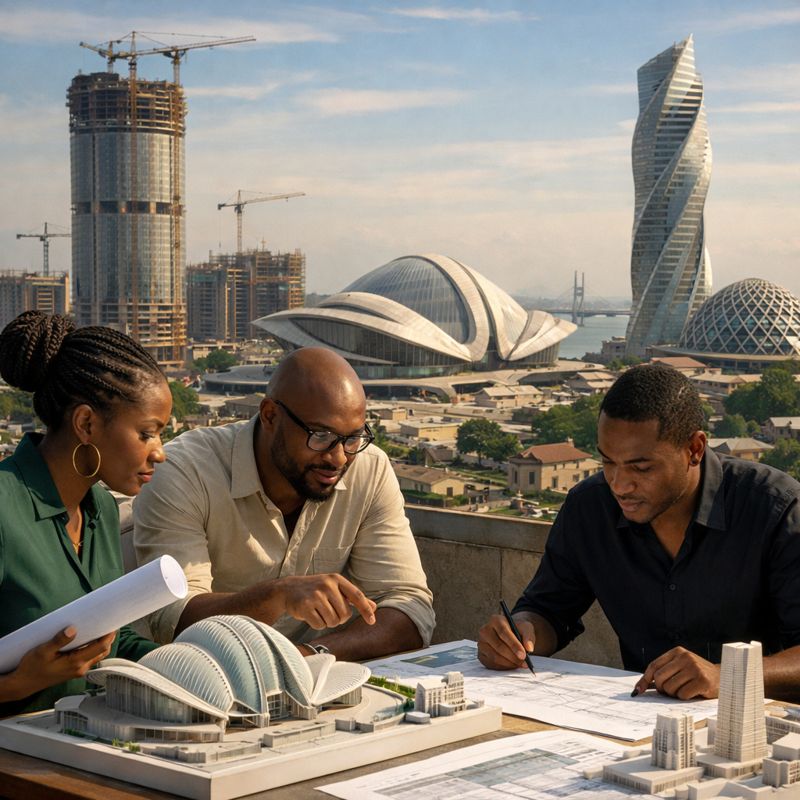
The Architects Designing Africa’s Next Landmark Buildings
Africa’s urban skyline is undergoing a profound transformation, shaped by a new generation of architects whose work reflects ambition, cultural confidence, and global relevance. Across the continent, landmark buildings are no longer defined primarily by imported aesthetics or foreign consultants. Instead, African architects are asserting design leadership, blending advanced engineering with local materials, climate-responsive strategies, and culturally rooted narratives.
From civic institutions and commercial towers to museums and mixed-use developments, these architects are redefining what iconic African architecture looks like in the 21st century—architecture that is innovative, contextual, and socially meaningful.
Related Articles: URBAN RENEWAL AND REGENERATION: BUILDING SMART, GREEN CITIES ACROSS AFRICA
West Africa: Nigeria’s Architectural Renaissance
In West Africa, Nigeria has emerged as a major hub of contemporary architectural innovation. Lagos, in particular, has become a laboratory for high-density, mixed-use developments responding to rapid urbanization, land scarcity, and environmental pressure.
Firms such as NLÉ Works, founded by Kunlé Adeyemi, have gained international recognition for challenging conventional notions of urban form and resilience. Adeyemi’s work emphasizes adaptive architecture, notably through floating and waterfront structures designed to respond to flooding and climate change. His influence extends beyond Nigeria, shaping broader conversations about sustainable urban living in coastal African cities.
Another prominent Nigerian firm, CMDesign Atelier, has contributed significantly to Lagos’ evolving commercial and residential landscape. By combining clean modernist aesthetics with context-sensitive planning, the firm prioritizes natural ventilation, spatial efficiency, and environmental responsiveness—critical considerations in one of Africa’s fastest-growing megacities. Collectively, these architects are not merely designing buildings; they are redefining how African cities will function in the decades ahead.
East Africa: Sustainability and Smart Design
In East Africa, Kenya’s architectural scene mirrors its position as a regional hub for finance, technology, and diplomacy. Nairobi’s skyline has been reshaped by architects who emphasize sustainability, efficiency, and smart building technologies.
Planning Systems Services (PSS), one of Kenya’s leading architectural firms, has played a key role in delivering high-rise commercial developments that meet international standards while remaining responsive to local climatic conditions. Energy-efficient façades, optimized daylight use, and flexible interior layouts define much of their work, aligning modern business needs with environmental responsibility.
Rwanda presents a distinct but equally compelling architectural narrative. Kigali’s rapid urban growth has been guided by disciplined planning frameworks that prioritize order, sustainability, and visual coherence. Internationally trained Rwandan architects and regional firms are delivering landmark projects—including convention centers, cultural institutions, and mixed-use districts—that symbolize national recovery and ambition. These structures project Rwanda’s image as a forward-looking, well-managed economy grounded in long-term planning.
Southern Africa: Architecture with Global Influence
Southern Africa has long been a center of architectural excellence, with South Africa continuing to produce architects whose influence extends far beyond the continent. David Adjaye, Ghanaian-British by heritage, has left a lasting imprint on African architecture through landmark projects that emphasize material honesty, sculptural form, and historical memory. His work demonstrates how architecture can serve as a vessel for storytelling—expressing identity, history, and aspiration.
Within South Africa itself, firms such as MASS Design Group Africa and Paragon Architects are shaping next-generation landmarks across healthcare, education, and commercial real estate. Their human-centered approach challenges the assumption that landmark architecture must serve only elite or commercial interests, illustrating instead how design can deliver tangible social outcomes.
North Africa: Tradition Meets Contemporary Design
North Africa represents another architectural frontier, where ancient urban traditions intersect with cutting-edge design. In Egypt, architects are contributing to ambitious national projects, including new administrative capitals, cultural districts, and transportation hubs. Increasingly, these firms are adopting parametric design tools and advanced construction technologies while drawing inspiration from Islamic geometry and vernacular architecture.
Similarly, in Morocco, architects are redefining urban landmarks in cities such as Casablanca and Rabat through mixed-use developments that integrate offices, residences, cultural venues, and public spaces. These projects reflect Morocco’s role as a bridge between Africa, Europe, and the Middle East, blending regional heritage with global design sensibilities.
Francophone Africa and a Continental Vision
Francophone West and Central Africa are also producing influential architectural voices. In Senegal, Dakar’s architectural resurgence is visible in cultural institutions, hospitality developments, and public buildings that emphasize openness and engagement with the Atlantic coastline. Architects across the region prioritize passive cooling, local craftsmanship, and indigenous materials such as laterite and timber, ensuring that landmark buildings remain environmentally responsive and culturally grounded.
Across Africa, a unifying theme among leading architects is the rejection of generic, one-size-fits-all design. Instead, they champion context-driven architecture that responds directly to climate, culture, and community needs. Advances in digital design tools, greater access to global knowledge networks, and increased public and private investment have empowered African architects to compete internationally while remaining rooted in local realities.
As Africa continues to urbanize, the architects shaping its next generation of landmark buildings will play a decisive role in defining how cities look, feel, and function. Their work extends beyond aesthetics, influencing sustainability, social cohesion, and economic productivity. By combining innovation with cultural authenticity, these architects are ensuring that Africa’s future landmarks are not only visually striking but also meaningful expressions of the continent’s evolving identity.




Related Articles

Off-Grid Energy Expansion: The Leaders Powering Africa’s Future
Access to reliable electricity remains one of Africa’s most critical development challenges....
TRANSFORMING EDUCATION: THE NEW UNIVERSITY AND TECHNICAL CAMPUS PROJECTS ACROSS THE CONTINENT
Across Africa’s diverse landscape, a quiet revolution in higher education is taking...

URBAN RENEWAL AND REGENERATION: BUILDING SMART, GREEN CITIES ACROSS AFRICA
Africa is urbanising faster than any region on the planet. By 2040,...



Africa’s New Oil Frontiers: Where Are the Next Big Discoveries?
In the heart of the 2020s, Africa is emerging as a significant...
